

The physicist Alan Lightman, walking around his small island in Maine, wrote:
The material of the doomed stars and the material of my doomed body are actually the same material. Literally the same atoms… It is astonishing but true that if I could attach a small tag to each of the atoms of my body and travel with them backward in time, I would find that those atoms originated in particular stars in the sky. Those exact atoms.
Close your eyes, breathe, and absorb that. A little tag on every atom in your body. Traced backward, each one leads to a star. Not starstuff in general. Particular stars. Those exact atoms.
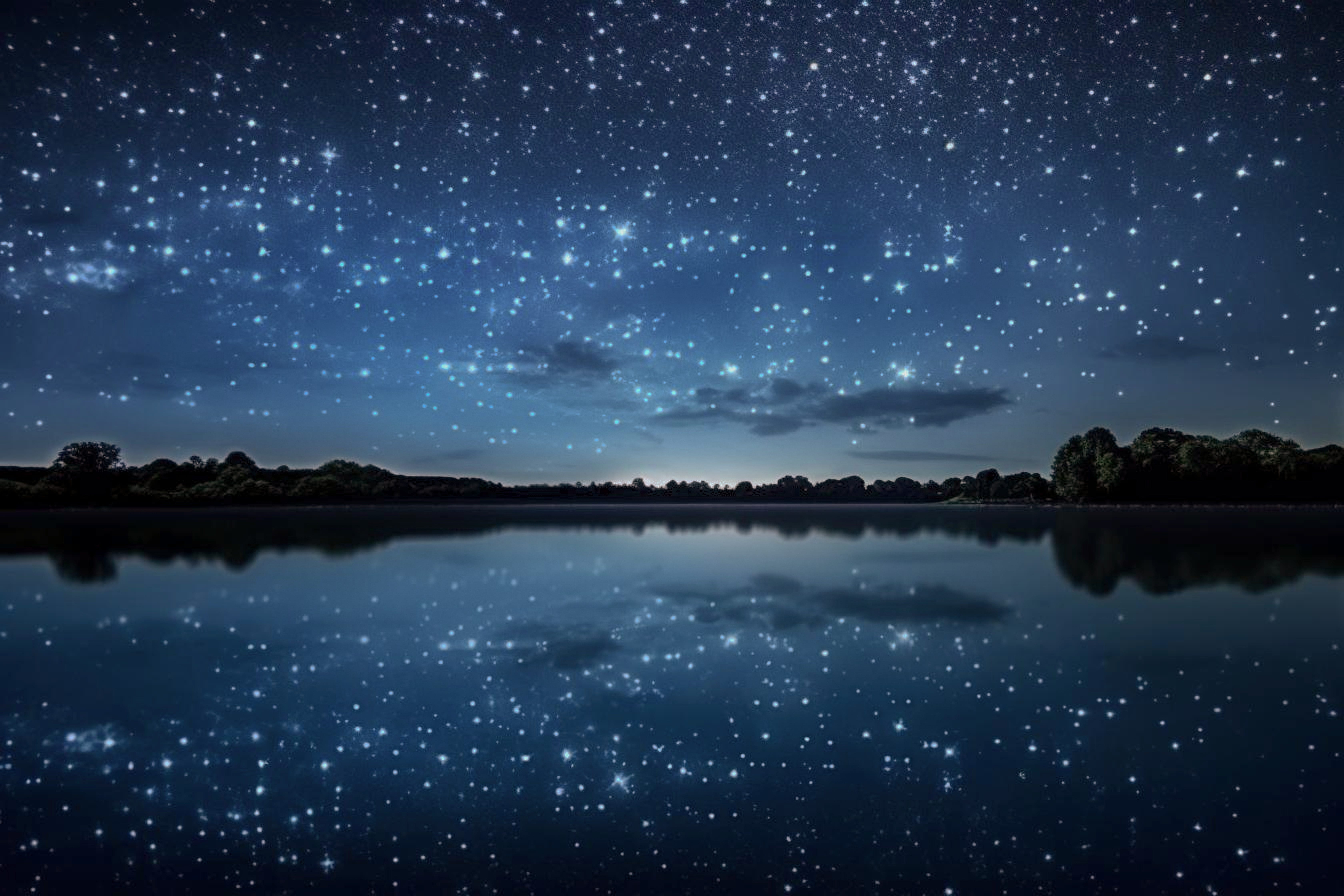
This isn’t poetry, like Marie Howe’s stunning Singularity. It’s just what happened. The universe started with hydrogen and helium, and everything heavier—the carbon in your cells, the oxygen you’re breathing, the iron in your blood—had to be cooked inside a star and then blown into space when that star died. You are, quite literally, the debris of dead suns.
Notice something about Lightman’s opening sentence, though. He says “doomed” twice. The doomed stars. His doomed body. And he says it cheerfully. He’s not lamenting. He’s comforted. The atoms go on, even when the star doesn’t. Even when the body doesn’t.
I find that comforting too. And I’ll take it a step further.
We are stardust. I know, I know. It’s one of the most used sentences in popular spirituality. It’s on yoga-studio posters. Joni Mitchell sang it. Carl Sagan said it best1. When a sentence gets that famous, it becomes a warm bath of vague cosmic oneness.
So let me be a contrarian. The vague version is cheap. What makes Lightman’s version powerful is how specific it is. A tag on each atom. Those exact atoms, in particular stars. Not a giant soup but a traceable history of actual stuff.
The Buddha was making the same kind of point—particular causes, particular conditions—25 centuries before we learned about nucleosynthesis. Nothing arises out of nowhere. Everything comes from something. This body came from stars, from parents, from food, from rain. Trace any of it backward and you never find a place where “me” begins. You find an unbroken chain of borrowing.
Which is why I find that understanding so comforting.
The most powerful argument I know for some kind of life after death isn’t a scripture or a near-death account or anything a lama ever told me. It’s this: everything else in the universe gets recycled.
Every atom in my body gets recycled. Every star that made those atoms got recycled. Water cycles. Energy conserves. The universe appears to throw away nothing—not one speck, not one joule. So why would the mindstream be the single exception? The one thing in all of creation that just stops?
I don’t know what form that continuation takes. I’m not claiming a soul with a mailing address. But I’m as sure as a contrarian can be—which is a humble kind of sure—that death is not the end. It would be the only dead end in a universe that doesn’t seem to have any.
Now, an honest objection, because I don’t do blind faith. Atoms recycle, sure, but they don’t carry memory. As far as we know, the carbon in my left hand doesn’t remember being in a star. So why should anything of “me” persist any more than the atom’s history persists in the atom?
Fair. But notice what that objection assumes: that continuation has to be made of stuff. Buddhism has a different picture, and it’s an old one. In the Milindapañha, the monk Nāgasena tells King Milinda that rebirth is like one lamp flame lighting another. Is the second flame the same flame as the first? No. Is it a completely different flame? Also no. What passes from lamp to lamp isn’t stuff. It’s pattern. A causal stream.
That’s what the mindstream is. It doesn’t travel the way an atom travels. It propagates the way flame propagates. And pattern is exactly the kind of thing the universe is good at conserving. The star dies and its pattern—its atoms, its light, its heat—keeps moving through everything that comes after. Nothing is lost. It’s all passed on.
Thich Nhat Hanh used to hold up a sheet of paper and ask: do you see the cloud in it? No cloud, no rain. No rain, no tree. No tree, no paper. The cloud never died. It just stopped being a cloud.
Lightman, standing on his island, is saying the same thing from the other side. The scientist traces the atoms backward. Thay traces the cloud forward. They meet in the middle, at this moment, at this body, at this breath.
Take a breath right now, if you like. Feel it come in. Some of that oxygen was exhaled by trees. Before that it was in the ocean. Before that, in a star. You’re not breathing in some abstract interconnection. You’re breathing in a specific, ongoing delivery. The universe is still handing things along, and for now, some of them are passing through you.
So where does that leave death?
Greeting death as a friend gets a lot easier when you stop thinking of your body as a possession and start thinking of it as a loan. The atoms were borrowed. They’ll be returned, with interest, into grass and birds and other people’s morning breath. And the mindstream—the pattern, the flame—goes where patterns go. Onward. Into whatever lights next.
That’s how I see Sukhavati, the Western Pure Land, where I’d like to be reborn. Whether it “really” exists as some sort of place doesn’t matter. How I live today—how I carry the flame—is what matters. Thich Nhat Hanh said the Kingdom of God is…Here and Now. So I live in a pure land already. When I die, if there “really” is a Buddha Amitabha who presides over Sukhavati, I’ll just be moving from this earthly pure land into a celestial one.
If not, I’ll die knowing that I did what I could to make this pure land even better.
My redesigned free author newsletter, Awakening to Joy: Buddhism - AI - The Human Frontier, comes out on the 1st and 15th of every month.
A Buddhist Path to Joy is available worldwide in ebook, paperback, and audiobook format.
From the Pure Land has thousands of readers and subscribers in 47 U.S. states and 47 countries. Subscribe to receive each article in your email inbox.
If this piece resonated, consider sharing it with a friend.
Visit our sister Substack.
“The cosmos is within us. We are made of star-stuff. We are a way for the universe to know itself.”


