
When My Pure Land Bubble Gets Punctured
An eyewitness account of a botched execution in Tennessee


I’m sometimes asked how I can say I live in a pure land when there’s so much trauma and suffering. My answer is that the world is a perfect balance of causes and conditions—an intricate web of everything each of us does, says, and maybe even thinks. I can work to prevent and alleviate as much suffering as I can, but beyond that I live by ethical and compassionate choices, and bear witness to the pain.
Sometimes, bearing witness breaks through the bubble of pure land joy I exist in. That happened this morning as I read For 90 Minutes, I Watched an Execution Go Horribly Awry by Maria DeLiberato on the New York Times opinion page. Sometimes it’s a mass atrocity leads me to some form of activism. Sometimes it’s a particularly act of violence against one person. My most effective way to practice Engaged Buddhism is to write and ask others to bear witness…and to act as best they can.
If you also see value in bearing witness, here’s a non-paywalled link to the article.
For 20 years, DeLiberato has worked as a capital defense attorney and anti–death penalty advocate. After trying and failing to prevent the State of Tennessee from killing her client Tony Carruthers, she vwalked into Riverbend Maximum Security Institution to witness the act…or, as it turned out, the attempted act.
Because Tennessee blocks reporters from observing the process of inserting the intravenous line, DeLiberato’s account is, as far as I can tell, the first fully detailed account of what happened over the next 90 minutes. Just reading it made me want to scream and stop what I was working on to write this first.
Here’s the context:
Carruthers was convicted for the 1994 kidnapping and murders of Marcellos Anderson, Anderson’s mother Delois, and family friend Frederick Tucker in Memphis. He received three death sentences in 1996 and has been on death row since—three decades.
Authorities have found no physical evidence, like DNA or fingerprints, that directly links Carruthers to the crime. Five fingerprints from the crime scene and unidentified DNA found with the victims do not match him.
The case was built on jailhouse informant testimony, and later litigation showed that a key witness, Alfredo Shaw, was a paid career informant whose role and compensation the state concealed for decades. In 2011, Carruthers’s co‑defendant identified another man as the real participant in the crime and stated that Carruthers was not involved, yet the unmatched DNA and fingerprints have never been tested against this alternative suspect despite repeated defense requests.
Appellate courts have repeatedly upheld his convictions and death sentences over the years, finding that the trial record, witness testimony, and circumstantial evidence were sufficient under Tennessee law to support the verdicts. Whether Tony Carruthers was guilty or not is a question the courts have answered, however imperfectly. What happened on that gurney is a different question entirely.
Since the 1970s, about 200 people have been exonerated and released from US death rows, almost always because of new evidence of innocence and, often, serious failures by their lawyers. That has not been the case for Carruthers, but after he sufferred for more than an hour from failed attempts to get a line in him to deliver his death, Governor Bill Lee postponed the execution for at least a year.
So taking a life in the name of the citizens of Tennessee was attempted by means that most would agree were cruel and unusual. After a half hour of failed attempts to find a vein to insert the needle, the doctor present decided to attempt to establish a central line. DeLiberato’s objection to the warden failed to prevent that even though the doctor had admitted in a deposition last year that he hadn’t performed one in over a decade and didn’t have privileges to perform one in any hospital in the country, according to her article.
She went on:
That moment revealed something deeply unsettling about the machinery of executions in America. The states that still execute people insist that executions are controlled, humane and medically precise. Yet a significant number of executions have gone awry in the past decade, causing agony for prisoners across the country.
To those of who follow the Buddhist First Precept—against taking life—and the principle of ahimsa, or non-harm, there’s little to debate about capital punishment. It’s tempting to want severe penalties for the harshest crimes, but even if the death penalty could always be legally sound and efficiently carried out, consider the harm done to those who take life—we the community.
According to the Death Penalty Information Center, some 140 countries have abolished the death penalty by law or practice and 54 retain it. In addition to the US, those retaining it include China, Iran, Saudi Arabia, Iraq, Egypt, North Korea, Vietnam, Yemen, Somalia, Japan, Singapore, Pakistan, India, Indonesia, and Nigeria.
Nevertheless, Amnesty International reports that 17 countries executed 2,707 people in 2025, the highest figure it recorded since 1981.
I wish I had an uplifting way to end this article. Instead, I’ll offer a way to do a bit more than witness, absorb, meditate, and pray. Consider supporting organizations like Death Penalty Action, Amnesty International, the Innocence Project and the Death Penalty Information Center.
May all beings be free from intentional harm.
From the Midwest Book Review:
“From Pain to Peace” offers a hopeful message: The path to peace is available to everyone.
So whether you are navigating your own grief, seeking spiritual guidance, or curious about how one man turned tragedy into grace, “From Pain to Peace” speaks to the universal longing for healing and wholeness.
Critique: Exceptional, eloquent, deeply personal but with a universal resonance, “From Pain to Peace: How Trauma and Tragedy Teach Us Compassion and Wisdom” is singularly extraordinary and an unreservedly recommended addition to personal, professional, community, and college/university library Contemporary Biography/Memoir collections and the personal reading lists of those with an interest in Tibetan Buddhism, love, loss, and the psychology of trauma.
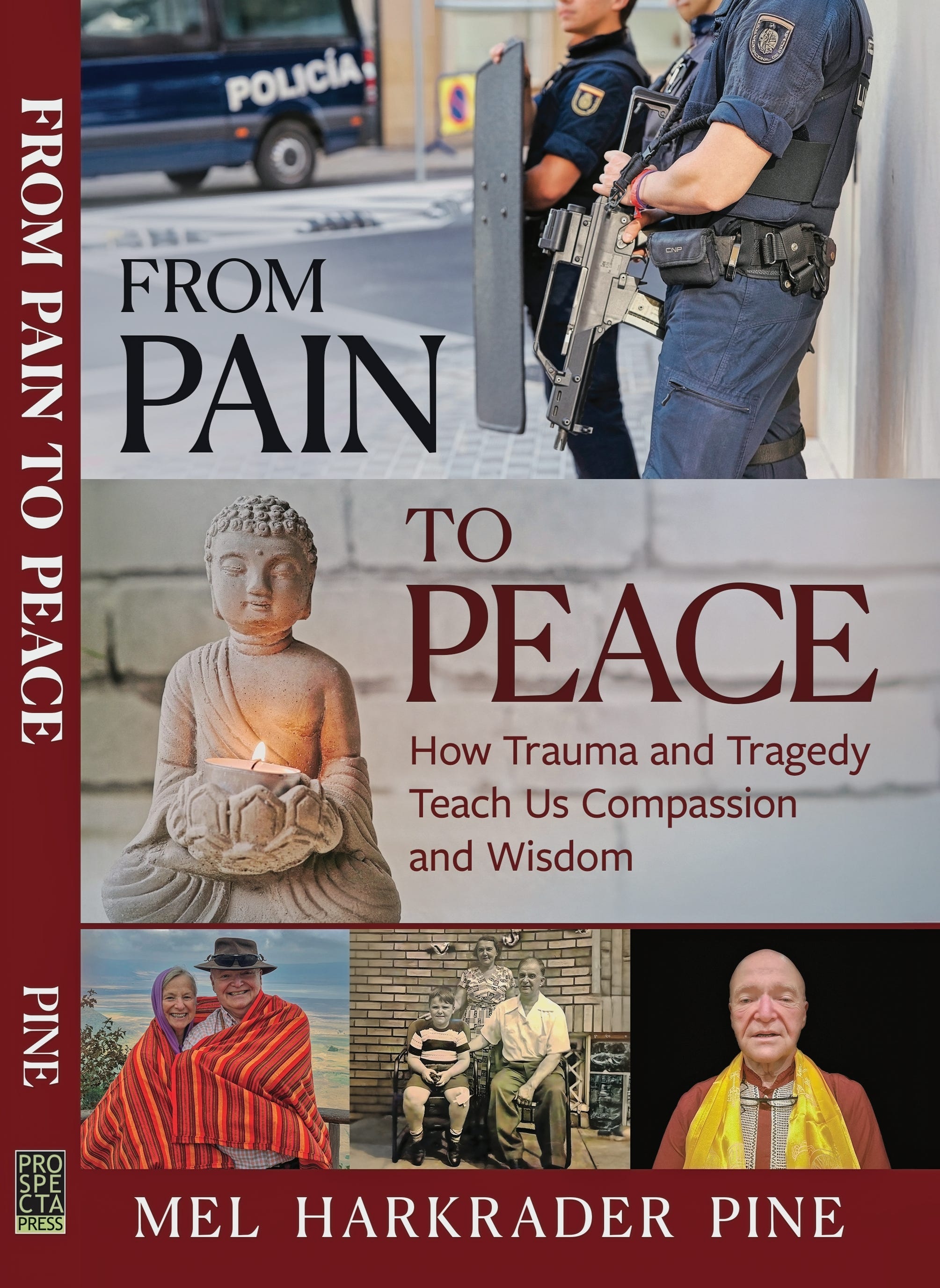
The book goes on sale September 15. You can help the book to a successful launch making an advance purchase now.
From the Pure Land has thousands of readers and subscribers in 45 U.S. states and 42 countries. Subscribe to receive each article in your email inbox.
If this piece resonated, consider sharing it with a friend.
Visit our sister Substack.
The death penalty usually prevents the spiritual process of repentance. The soul learns from the pain of repentance. Souls lesrn nothing from a state sanctioned execution. Plus, life sentences costs the government significantly less than the legal costs incurred with an execution.