
What Makes a Person Good?
Let's examine virtue using modern and ancient wisdom

Western philosophy has spent centuries trying to decide the best way to structure cultures to foster goodness in people and the best way to identify those people. What makes somone good? What quality, what disposition, what way of being in the world distinguishes someone you’d trust with your life from someone you’d cross the street to avoid?
If you’ve spent any time studying ethics in the Western tradition, you know the two big answers and a third less often cited. The first, associated with Immanuel Kant and the deontological school, says goodness comes from following the right rules. Don’t lie. Don’t steal. Treat people as ends, not means. Figure out the correct principles and apply them consistently. The second, utilitarianism, says goodness is about outcomes. The right action is whatever produces the most happiness or well-being for the most people. Calculate the consequences and choose accordingly.
Both approaches have obvious appeal. Both have problems.
Rule-following breaks down the moment two rules conflict. You’re hiding refugees in your attic and the soldiers knock on the door. Do you lie or do you hand them over? Kant, famously, said you should tell the truth. Most of us find that answer cowardly.
Consequentialism breaks down because we can’t actually calculate the future. Every action ripples outward in ways we can’t predict. And taken to its logical extreme, it can justify terrible things done to individuals in the name of aggregate well-being.
The third answer predates both Kant and the utilitarians by two millennia. It was Aristotle’s answer, which has much in common with the Buddha’s answer. It goes something like this: Stop asking “What should I do?” and start asking “What kind of person should I be?”


This approach is called virtue ethics, and its central insight is simple. A good person isn’t someone who follows the right rules or calculates the best outcomes. A good person is someone who has cultivated good character—who has developed virtues like courage, honesty, compassion, wisdom, and justice until they’ve become second nature.
The key word there is cultivated. For Aristotle, virtues aren’t things you’re born with. They’re habits of mind and heart that you develop through practice. You become brave by doing brave things. You become honest by telling the truth even when it’s inconvenient. You become generous by giving. The practice comes first. The character follows.
And here’s what makes virtue ethics stand out from the rule-followers and the calculators: it acknowledges that moral life is messy. There is no algorithm for being good. Virtuous individuals aren’t guided by a rulebook or a calculator. They see the situation clearly, they feel the appropriate response, and they act. Aristotle called this phronesis—practical wisdom. The ability to perceive what a situation actually requires and respond accordingly.
This means that two virtuous people might respond differently to the same situation, and both might be right. It depends on context, on relationships, on timing, on a thousand factors that no rulebook could anticipate. Virtue ethics trusts the person, not the formula.
If any of this is starting to sound familiar, there’s a reason.
Buddhism has never been a rule-based ethical system. Yes, there are precepts—principles. Undertake the practice of not killing, stealing, lying, engaging in sexual misconduct, or taking intoxicants. But anyone who has practiced seriously knows that these aren’t commandments carved in stone. They’re training principles—descriptions of how a person naturally behaves when greed, hatred, and delusion begin to thin out. They recognize that we’re adults who will have to make difficult decisions.
The real ethical heart of Buddhism is the cultivation of character. The paramitas (perfections) are virtue ethics in everything but name. Generosity. Ethical conduct. Patience. Energetic effort. Meditative concentration. Wisdom. These aren’t rules to obey. They’re qualities to develop. Dispositions to cultivate through practice until they become who you are.
You become brave by doing brave things. You become generous by giving. Aristotle would have recognized a paramita immediately.
The parallels run deeper than a shared list of good qualities. Both traditions understand that ethical development is a practice—something you do daily, not a conclusion you arrive at once and then carry around in your pocket. Both understand that wisdom is the master virtue, the quality that allows you to perceive clearly what each moment actually requires. Both understand that rules alone will always fall short, because the moral landscape is too varied, too textured, too alive to be captured in any set of propositions.
The Eightfold Path itself is a curriculum in virtue development. Right View, Right Intention, Right Speech, Right Action, Right Livelihood, Right Effort, Right Mindfulness, Right Concentration. These aren’t eight rules. They’re eight dimensions of character to be cultivated simultaneously, each supporting the others, the whole thing held together by the practical wisdom that comes from sustained contemplative practice.
And both traditions share a crucial understanding about the relationship between inner and outer. You don’t become compassionate by performing compassionate acts while seething inside. You don’t achieve right speech by biting your tongue. Real virtue—real sila, real paramita—arises from transformation of character. The actions flow from the being. Not the other way around.
I’d be doing both traditions a disservice if I pretended the alignment is perfect.
Aristotle was interested in human flourishing—eudaimonia—which he understood as a life of virtue within a political community. His ethics were thoroughly this-worldly. Buddhism aims at something more radical: the end of suffering through the dissolution of the very self that Aristotle was trying to perfect.
That’s not a small difference. Aristotle wanted to build a better self. The Buddha wanted to see through the illusion of self entirely. The virtues that Aristotle cultivated were meant to make people more fully themselves. The paramitas that a bodhisattva develops are meant to dissolve the boundary between self and other altogether.
And yet. The daily practice looks remarkably similar. Sit. Pay attention. Notice your reactions. Cultivate patience when you want to react. Practice generosity when you want to hold on to things. Speak truthfully even when it costs you something. Show up again tomorrow and do it all again.
Maybe the metaphysics diverge while the practice converges. That wouldn’t be the first time in the history of ideas.
I began thinking about virtue ethics as I was listening to a fascinating interview of Amanda Askell, the chief author of Anthropic’s Claude’s Constitution, the framework that Anthropic uses to train its AI assistants in how to behave with their human users. It avoids rigid rules in favor of value ethics with some firm guardrails. Askell used this example of how relying on rigid rules can go wrong:
Suppose that you’re trying to have models navigate people who are in difficult emotional states and you gave a set of rules that were like, you must refer to this specific external resource. You must take this series of steps. And then the model encounters someone for whom those steps are simply not actually going to help…if the model then responds in this rule-following way…(M)odels are extremely smart. And so they might even know, this isn’t what this person needs right now. And yet I’m doing it, anyway.
Askell, who has a Ph.D. in philosophy, makes the point that the rigid rule in this case might not only fail the user in distress. It might reinforce for the AI that’s its character is to follow rules even if they fail to be the best for the human asking for help.
I have an explainer on Claude’s Constitution and much more on Anthropic planned for this Substack’s sister blog, From the Lighthouse. I brought that example up here to show how the modern world still benefits from an ethical philosophy taught by the Buddha and Aristotle.
We live in an age that wants algorithms. Clear rules. Step-by-step instructions. Ten tips for enlightenment. The dharma gets reduced to techniques—this meditation for anxiety, that practice for focus, these precepts for ethical living. And techniques have their place.
But the heart of what the Buddha taught—and the heart of what Aristotle taught—is that there is no substitute for the slow, patient cultivation of character. No shortcut. No hack. You sit on the cushion not just to feel calm but to become the kind of person who sees clearly. You practice generosity not to accumulate merit but to become generous. You cultivate compassion not because it’s a rule but because that’s what a person looks like when delusion starts to fall away.
Virtue ethics isn’t Buddhist. Buddhism isn’t virtue ethics. But they share something precious: the conviction that goodness is a practice, not a position. That character is built daily, in small choices, over years. That wisdom—not rules, not calculations—is what allows us to meet each unrepeatable moment with something approaching grace.
Which is, when you think about it, exactly what happens on the cushion. Every single morning. Whether we feel like it or not.
A Peek at What’s Coming
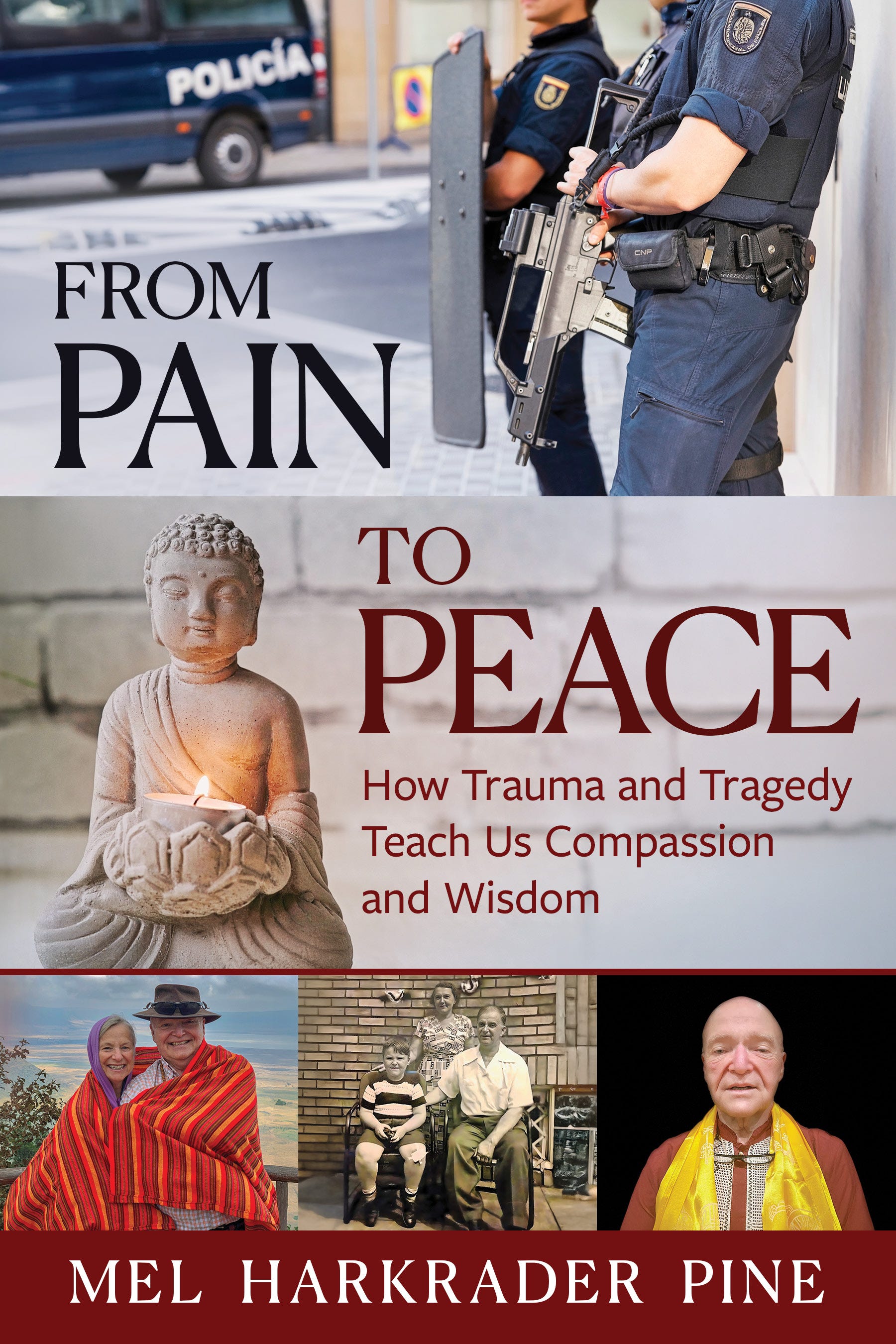
We all experience suffering. But what if your deepest pain could lead to your greatest peace?
In this powerful spiritual memoir, Mel Pine—a Buddhist practitioner with nearly eight decades of life experience—opens his heart to share how a lifetime of traumas became stepping stones to wisdom, compassion, and ultimately, joy.
From early childhood losses to violent crises, from caring for loved ones with mental illness to confronting his family’s Holocaust history, Pine’s journey is raw, honest, and deeply human. Yet this isn’t a story of mere survival—it’s a testament to transformation.
Alternating between memoir chapters and “Spiritual Interludes,” Pine weaves Buddhist teachings with hard-won life lessons, showing how concepts like impermanence, equanimity, and self-compassion become practical tools for healing.
Publication date October 6, 2016. Subscribe to my very occasional author newsletter to stay informed.
From the Pure Land has thousands of readers and subscribers in 43 U.S. states and 37 countries, and the podcast has thousands of listeners in 19 countries.
If this piece resonated, consider sharing it with a friend.
Beautiful! Enlightening!