
The Metaphysical Trolley Problem


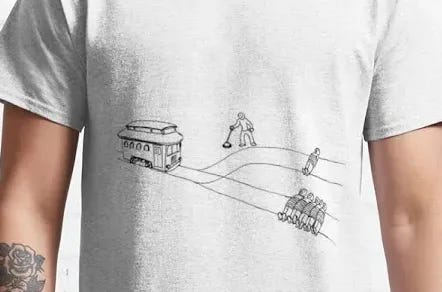
Most of us know the Trolley Problem as an interesting thought experiment in ethics. Adding the word “Metaphysical” to it invites deeper thought. I thank author and philosopher Mark Siderits for reminding me of the Metaphysical Trolley Problem in the video released today as part of Wisdom Academy’s online course Wisdom as Philosophy: Nonself and Reality. Siderits even wore a T-shirt similar to this one:
To recap the trolley problem:
A trolley is barreling out of control on a track where four people are tied. There is no time for it to stop. You are standing next to a switch that could divert the trolley to a track where only one person is tied. There is not enough time for you to take any other action. What do you do?
One has to decide whether a conscious overt act to take one life is acceptable to save the lives of four people. There’s no right or wrong. The object is to use the problem to examine your convictions.
I once presented the problem to around 50 attendees at a church service. Only one person held fast to the belief that acting to take a life was always wrong, even if it saved other lives. He felt a decision like that is beyond the pay grade of us mortal humans. I admire his conviction and willingness to stand out from the other participants.
The first of the five precepts for lay Buddhists is to refrain from taking life. Even so, the precepts are guides, not commandments. For me, the test for any act is whether it will reduce rather than increase suffering. But how can one be sure? I come back to the Taoist parable of the Chinese farmer who always said “maybe” to whether an event was lucky or unlucky. He understood that consequences can’t be predicted. We can only be guided by our unbiased best intentions.
Many thinkers and writers have devised ways to complicate the Trolley Problem. Standing on a bridge over the track and deciding about jumping or pushing someone onto it is one example. I’ll keep my complication simple. (Was that an oxymoron?)
What if you know nothing about the four people who would die, but you recognize the one person you would have to kill to save them? Does it make a difference? Does it make a difference if that person is your neighbor, a friend, a loved one, a son or daughter, a respected spiritual teacher? Does it make a difference if that person is young or old?
What if the one person is young and the four appear over 70? What if the four are displaying the insignias of a murderous terrorist organization?
You might think of your own questions to ask yourself. Again, the point isn’t to answer the question but to probe your values.
Here’s an admission. When I ponder questions like this, I think of the one person whose life I would have been happy to end. The federal government did that for me on June 11, 2001. And no, I don’t believe in capital punishment. And yes, I understand that revenge is not justice. And yet…
If I had been asked to administer the fatal injection, if I could have pulled a switch to send a runaway trolley over him, I would gladly have done it to Timothy McVeigh (1968-2001).
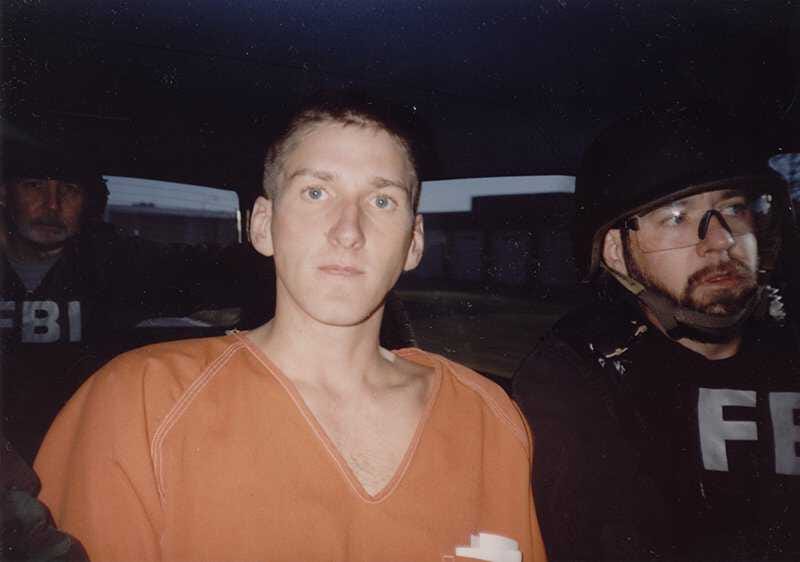
It must have something to do with my age and life status in 1995 when he masterminded and carried out the Oklahoma City bombing, which killed 168 people, including 19 children, and injured 684. It certainly has to do with his proud and unapologetic attitude after being captured and up to the time of his death. Upon his execution, he provided a handwritten statement that, in part, said:
I thank whatever gods may be for my unconquerable soul. In the fell clutch of circumstance, I have not winced nor cried aloud. Under the bludgeoning of chance, my head is bloodied but unbowed…. I am the master of my fate. I am the captain of my soul.
If you’d like to learn more about the Oklahoma City bombing, McVeigh, and the rise of extremist American “patriots,” I recommend Jeffrey Toobin’s book Homegrown: Timothy McVeigh and the Rise of Right-Wing Extremism.
We’ve seen far too many inexcusable acts of terrorism since 1995, but for some reason, I’m stuck (attached?) to my willingness to take McVeigh’s life.
What would the Chinese farmer say about my good or bad luck to be reminded repeatedly about Timothy McVeigh and my failure to have a pure and compassionate mind toward him, my failure to accept that he was the product of causes and conditions and could be no other than what he was?
Maybe it’s good luck to be reminded of my imperfections.
From the Pure Land has thousands of readers and subscribers in 38 U.S. states and 19 countries, and the podcast has thousands of listeners in 54 countries.
The Buddha emphasized the joy of giving. Dana is not meant to be obligatory or done reluctantly. Instead, dana should be performed when the giver is “delighted before, during, and after giving.” —Gil Fronsdal.
Consider being delighted by paying for your subscription even though you’ll receive the same regular content as those with a free subscription. For $5 a month or $50 a year, you’ll contribute to Mel’s expenses and see parts of his book Slicing and Dicing Buddhism as it progresses.
Make a one-time gift to Mel of any amount using the Venmo QR code:

Share this post with a friend.
Listen and subscribe to the From the Pure Land podcasts via your favorite app or by clicking here.