
The Judge We Carry
A psychologist’s “tyranny of the should,” the Buddha’s skillful and unskillful, and why real ethics begins where the gavel falls silent.


There is a woman in Jeffrey Fracher’s consulting room, a former patient he calls Margaret, and by every external measure she is good. She goes to church. She is generous. She is devoted to her family. She also spends most of her waking hours condemning herself for ordinary things: eating the wrong food, snapping at her husband, forgetting to call her mother. Fracher, a clinical psychologist of 45 years and a Buddhist practitioner of nearly 30, has a name for what runs her life. He calls it “the tyranny of the should.”
I came across Margaret in Fracher’s essay The Judge in the Room (and why it is important), on his Substack, Practical Dharma, and she has stayed with me. Not because she is unusual, but because she is so familiar. Most of us keep a judge in the room. Fracher describes it as a surveillance system “that never powers down.” Margaret’s suffering, he writes, was “not a failure of morality. It was morality gone wrong. Rules without roots. Compliance without understanding. Goodness performed for a judge who was never, ever satisfied.”
I understand Fracher’s judge because so many people have told me about theirs. Having grown up with almost no parenting, I lack that stern judge others tell me about. Mine is a wimp. I sometimes wish he or she would be less wimpy about important things, like sending that thank-you note that’s overdue. Maybe I just should be thankful my judge isn’t a tyrant.
Fracher’s diagnosis is precise, and it is not that the rules were too strict. He argues that rigid moral systems cause suffering because they “externalize moral agency.” They move the locus of control out of our own hands and into the hands of an authority, an institution, an internalized set of commandments. Once that move is made, the question changes. It stops being “What is the wise thing to do here?” and becomes “Will I be caught? Will I be condemned? Am I bad?” His verdict is one of the cleaner sentences I have read on the subject:
That’s not ethics. That’s fear with a faith-based costume on.
This is the territory I tried to map in my book A Buddhist Path to Joy. I put it there as plainly as I could: “Instead of commandments and sins, the Buddha talked about ‘skillful’ and ‘unskillful’ (kusala and akusala in Sanskrit) actions.” A skillful action reduces suffering and moves us toward awakening. An unskillful one perpetuates suffering and gets in the way. The frame is pragmatic rather than punitive. It asks about intentions and consequences, not about good and evil, and it keeps the focus on what an action does rather than on what it proves about your worth.
That last point matters more than it first appears. By this measure, the judge in the room fails its own test. Self-condemnation does not reduce suffering. It manufactures it. Margaret’s relentless inner gavel produced no more kindness, no more honesty, no more care for the people around her. It produced only more suffering, which is the definition of unskillful. The voice that presents itself as the guardian of your morality is, by the Buddha’s own standard, behaving unskillfully.
There is a story well known in Buddhism. Two monks, one senior to the other, come upon a young woman stranded at a riverbank. Their precepts forbid touching a woman, yet the elder monk lifts her and carries her across the rushing water. They walk on for hours before the younger monk can no longer contain himself: How could you break our vows? The elder replies:
I set her down on the other side of the river. Why are you still carrying her?
The lessons in that story are many, but here is the one that speaks to Margaret: as I wrote, The younger monk took a transient distraction and treated it as a moral dilemma. That is the judge at work. It takes a small, human moment and inflates it into a trial.
None of this means the precepts are disposable. Lay Buddhists keep five: we endeavor not to take life, take what is not offered, misbehave sexually, lie, or use intoxicants. Fracher calls such precepts “the floor of the moral life, not the ceiling,” and that is exactly right. They orient us; they do not decide for us.
The hundreds of choices we actually navigate in a day ask for something a list cannot supply. They ask for discernment. In my book, I described the precepts as “guides to help us live skillfully,” and I noted that in the Buddhist communities I have known, “we don’t judge each other’s interpretation of the precepts.” The absence of mutual judgment is not laxity. It is the recognition that ethics lives in wisdom, not in surveillance.
As Fracher notes, there’s danger here, too. Once you relocate ethics from obedience to intention, you hand the ego a gift, and the ego is resourceful. It would rather justify a harm than risk self-condemnation. “It wasn’t that bad. They deserved it. Everyone does it.”
This is where meditation stops being stress reduction and becomes the ground the whole structure stands on. Sitting, we practice catching the exact moment rationalization begins its seductive whisper. Fracher calls mindfulness “courageous attending,” a willingness to shine a light into the corners where our excuses hide. The aim is not to convict ourselves. That is only the judge in a new outfit. The aim is to see.
We don’t choose our punishing inner voice. It’s often delivered by trauma. Sometimes it takes the form of a label rather than a should. Often, it’s: “I’m a victim.” The Buddha’s image of the two arrows fits here. The first arrow is the pain life delivers. The second is the one we add ourselves. The sympathetic voice labeling us as victims and the harsh voice judging us both remove us from our own agency.
In my coming spiritual memoir, From Pain to Peace: How Trauma and Tragedy Teach Us Compassion and Wisdom, I describe how the advice to stop being a victim, combined with maturity in my spiritual practice, enabled me to extract myself from the “Mother of All Midlife Crises.”
Skillful living means learning to dodge the second arrow.
The judge thrives in isolation. Its power depends on the feeling that you are alone in the dock. Buddhist ethics isn’t meant to be a solo audit. Last month, more than 50 scholars from seven countries met at Harvard for a forum on Applied Buddhism and the Contemporary Bodhisattva Path. Two examples from that gathering emphasize how the sangha has long been a force for community health.
Princeton’s Stephen Teiser presented liturgical handbooks recovered from the Dunhuang caves that once guided practitioners in comforting people during epidemics, when medicine had little to offer. And the Harvard-Yenching Institute’s James Robson described Iwakura, a village near Kyoto that since the ninth century has cared for people with mental illness through a temple-centered, holistic community. These are very old systems of care—the sangha doing what sangha is for: holding the suffering person rather than sentencing him. The judge isolates. The community holds.
May all beings be free from the judge who never rests. May all beings meet their own stumbling with curiosity instead of contempt. May all beings have the support of their community.
My free newsletter, Awakening to Joy: Buddhism - AI - The Human Frontier, brings news and insights twice a month.
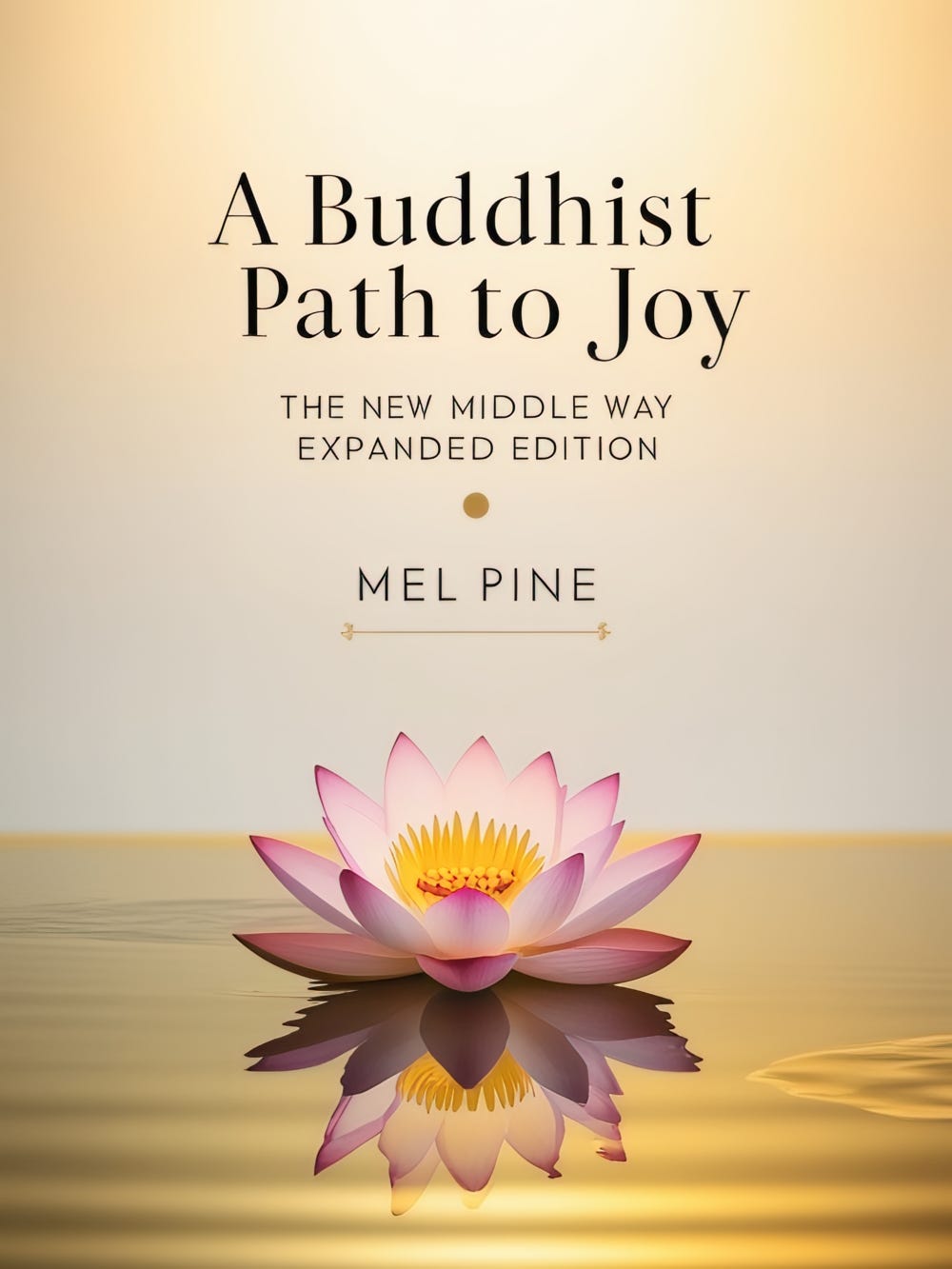
A Buddhist Path to Joy is available worldwide in ebook, paperback, and audiobook format.
From the Pure Land has thousands of readers and subscribers in 45 U.S. states and 43 countries. Subscribe to receive each article in your email inbox.
If this piece resonated, consider sharing it with a friend.
Visit our sister Substack.
Love it!