
Teacher Is Still Teaching
Plum Village introduces the Living Gems searchable archive of Thich Nhat Hanh's wisdom

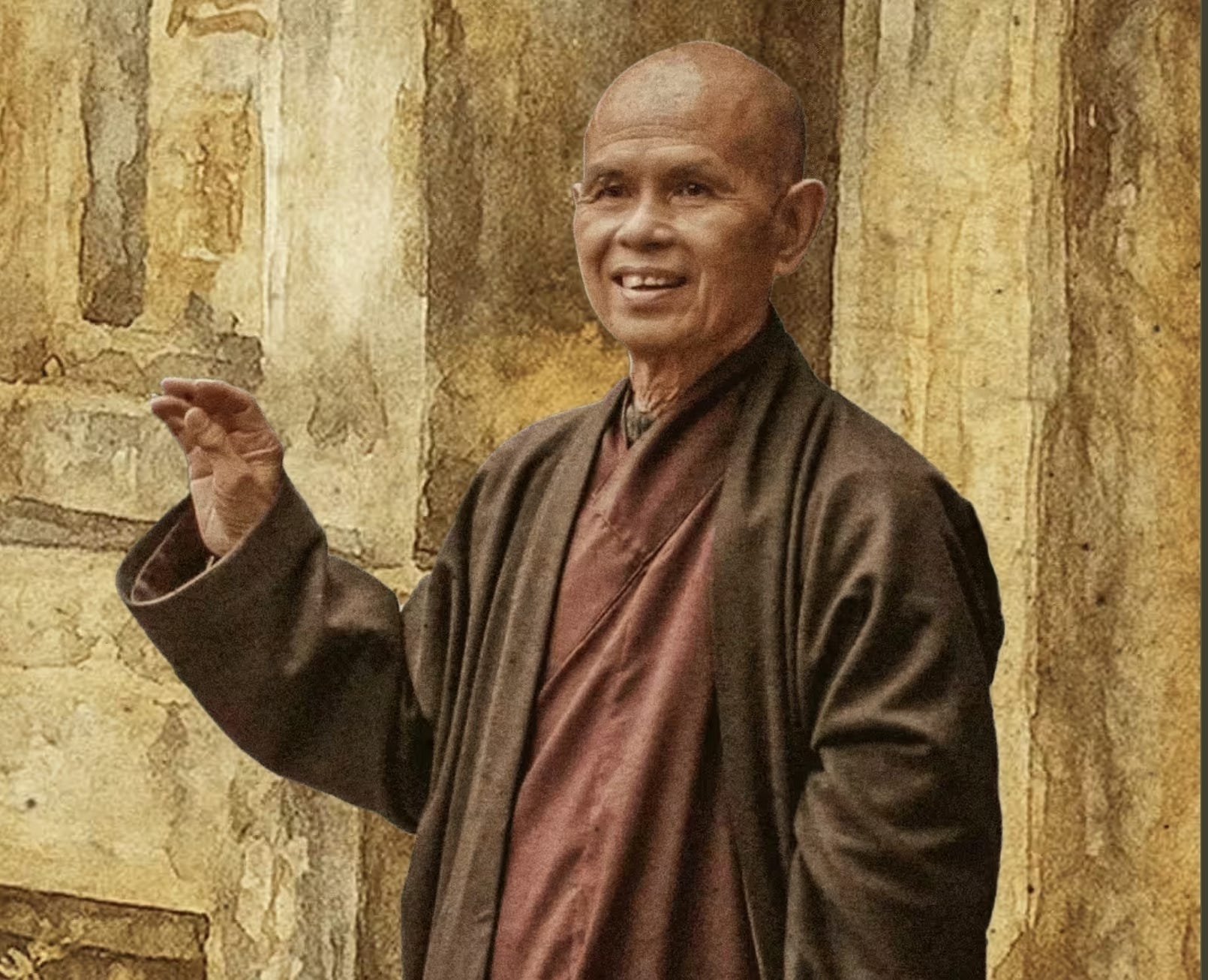
Thich Nhat Hanh died on January 22, 2022, at Từ Hiếu Temple in Huế, Vietnam. He was ninety-five. For those of us whose practice was shaped by his teachings, the loss was both immense and, in the way he would have wanted us to understand, not quite what it appeared to be.
A teacher’s continuation, in the Buddhist understanding, isn’t metaphorical. It’s literal. The teachings continue in the students who practice them. The sangha continues in the communities that gather. The dharma continues in every moment of mindful breathing, every bell of awareness, every act of deep listening that someone performs because a small Vietnamese monk once showed how.
He authored 150 books, translated into 40 languages. Over 25-30 years of dedicating traveling, he gave at least 3,700 recorded dharma talks. The Daily Lama is the only contemporary Buddhist author whose output compares, but Thay (or “teacher,” as Nhat Hanh is known) always spoke and wrote in terms accessible to anyone willing to listen or read.
Among non-Buddhist spiritual writers, Thomas Merton is probably the closest Western parallel in terms of combining contemplative depth with prolific, accessible output. Merton recognized Thay as a kindred spirit, writing “Nhat Hanh is my Brother” in 1966.
Plum Village, the global community founded by Thay, has just made his teachings even more accessible.
After nearly three years of painstaking work—collecting, digitizing, restoring, and organizing recordings from across decades of Thay’s teaching life—the Plum Village community launched Living Gems, the world’s largest searchable archive of Thich Nhat Hanh’s teachings.
The numbers alone are striking: 3,007 talks currently available—including dharma talks, question-and-answer sessions, guided meditations, and interviews. Many have never been published in any form before.
What’s especially astounding is the way it’s designed to be used.
You can search inside the talks. Not just by title or date, but by topic, by question, by the specific concern that brought you to the teachings in the first place. If you’re struggling with fear, you can search for how Thay addressed fear. The platform will take you to the specific passage in a specific talk where he responded to your question. The talks are split into chapters, so you arrive at the section that speaks to your condition rather than scrolling through hours of video hoping to find it.
Sister True Dedication, one of Thay’s senior students, captures what this means for the Vietnamese-language teachings in particular: some of the richest and deepest teachings were given in Vietnamese, and they’ve been largely inaccessible to the wider sangha until now. Living Gems makes them findable and, with transcripts and subtitles in English, French, and Vietnamese, increasingly accessible across languages.
There are curated collections on themes—“The Ethics of Hiroshima,” “The Way Out Is In,” “The Flame Is Always There”—assembled by a curation team of monastics and lay practitioners. You can also create your own collections and playlists to support your personal practice or your sangha’s study.
Brother Phap Huu, Thay’s attendant for many years, said:
I can feel the joy and smile of our late teacher, knowing that we are working together to make his teachings accessible.
The technical work behind Living Gems is itself a practice of mindfulness.
The team has been working with recordings in every format imaginable: VHS tapes, camera tapes, audio recordings, mini discs. Some of the materials were degraded by time and storage. The restoration process involves digitizing the raw magnetic signal, de-noising the audio, de-interlacing the video, and cleaning up decades of accumulated artifacts—all to preserve the quality of what Thay said and how he said it.
Anyone who has heard Thay speak knows that the pauses matter as much as the words. The bell between sentences. The silence he let settle before answering a question. Preserving that quality—not just the information content but the experiential texture of being in the room with him—is what transforms an archive into a living teaching.
The platform also invites community participation. Transcripts are being reviewed and corrected by sangha members, and if you notice an error, you can suggest an edit. The whole project embodies what Thay taught about community: no one does this alone. The continuation is collective.
Living Gems operates on a “Pay What You Wish” model—free to access with an account, with supporters gaining unlimited access while helping fund the ongoing work. As of this writing, the project has raised $21,383 toward an $800,000 goal, with 472 supporters. That’s 2.7% of what’s needed to continue digitizing new material, improving existing content, creating curated collections, and developing the platform.
If you’ve ever sat in a room with Thay, or wished you had, or if his books opened a door you’ve been walking through ever since—this is a way to support the continuation of his teaching in a form that will outlast all of us.
I has been a blessing for me to have sat in a room with Thay a couple dozen times, including a six-day retreat in September 2000 at the Ascutney Mountain Resort in Vermont. My first in-person encounter was a talk he gave in New York City more than 10 years earlier. Overall, I considered him my primary teacher for 30 years. The language he used, the jokes he made, the analogies he introduced, varied, but the core messages never changed:
Present moment, only moment. Mindfulness—present-moment awareness—isn’t a technique. It’s the ground of all practice, all ethics, all relationship. “The present moment is the only moment available to us, and it is the door to all moments.” It’s also a refuge, a safe place where you’re free from yesterday’s demons and tomorrow’s fears.
Interbeing. Nothing exists independently. The paper contains the cloud, the logger, the sun. “To be” is always “to inter-be.” This is his accessible rendering of dependent origination (pratītyasamutpāda), and it’s the concept most associated with his name. It applies to ecology, relationships, politics, self-understanding—everything.
Suffering as compost. “No mud, no lotus.” Suffering isn’t to be escaped or eliminated—it’s the raw material of awakening. Without suffering, compassion cannot develop. The practice is to be present to suffering (your own and others’) without being overwhelmed by it. This transforms the relationship to pain from avoidance to engagement.
The interconnection of inner and outer peace. “There is no way to peace; peace is the way.” Peace isn’t a destination achieved through conflict. It’s a practice embodied in each moment. Personal mindfulness practice is inseparable from actions to relieve suffering in the day-to-day world. This is his “engaged Buddhism.” His Five Mindfulness Trainings are simultaneously personal ethical commitments and a social program.
Deep listening and loving speech. Communication as spiritual practice. “The most precious gift we can offer anyone is our attention.” Deep listening means hearing what’s being said—and what’s underneath what’s being said—without judgment. Loving speech means speaking truthfully and kindly. These two practices, he taught, can restore any relationship.
The non-self (anattā) presented gently. Rather than the sometimes austere Buddhist teaching that the self is an illusion, Thay taught this as liberation: you are not a separate, fixed entity. You are a river, always flowing, always connected. This removes the fear from the teaching and makes it joyful rather than disorienting.
Continuation rather than death. “This body is not me; I am not caught in this body. I am life without boundaries.” Death isn’t annihilation—it’s transformation. The cloud doesn’t die; it becomes rain. This teaching, developed most fully in No Death, No Fear, is his rendering of the Buddhist understanding of impermanence applied to mortality. Perhaps my favorite teaching from Thay is his talk with an autumn leaf.
Taking care of strong emotions. Anger, fear, despair—these are not enemies. They are suffering children inside us that need our mindfulness, not our rejection. “Holding your anger as a mother holds her crying baby.” This metaphor—treating your own difficult emotions with the tenderness you’d give an infant—may be his most therapeutically influential image.
Beginning anew. The practice of acknowledging harm, expressing regret, and starting fresh—available in every moment. Not waiting for a special occasion or ceremony. “Because you are alive, everything is possible.”
Religion as universal. The quotation I remember most vividly from the 2000 retreat: “In the beginning it’s OK to believe that God is out there. Eventually, you learn that God is in here.” He didn’t shy away from using the “G” word. He saw the core similarity, not the surface differences, in religion. I often recommend his book Living Buddha, Living Christ.
I’ll close with this recitation of Thay’s conversation with a falling leaf.
From the Pure Land has thousands of readers and subscribers in 43 U.S. states and 36 countries. Subscribe to receive each article in your email inbox.
If this piece resonated, consider sharing it with a friend.
Visit our sister Substack.
Wow, that's so good to hear. What a profound and helpful post.
Thank you for sharing this wonderful news! I didn’t know about this project and am delighted to know about it now. Your crystallizations of Thầy’s central teachings are beautiful and added a lovely mindful shimmer to my morning today. 🙏🏼💖🙏🏼