
Nagarjuna Helps Me Enter a Contest
I'll let you know if I win

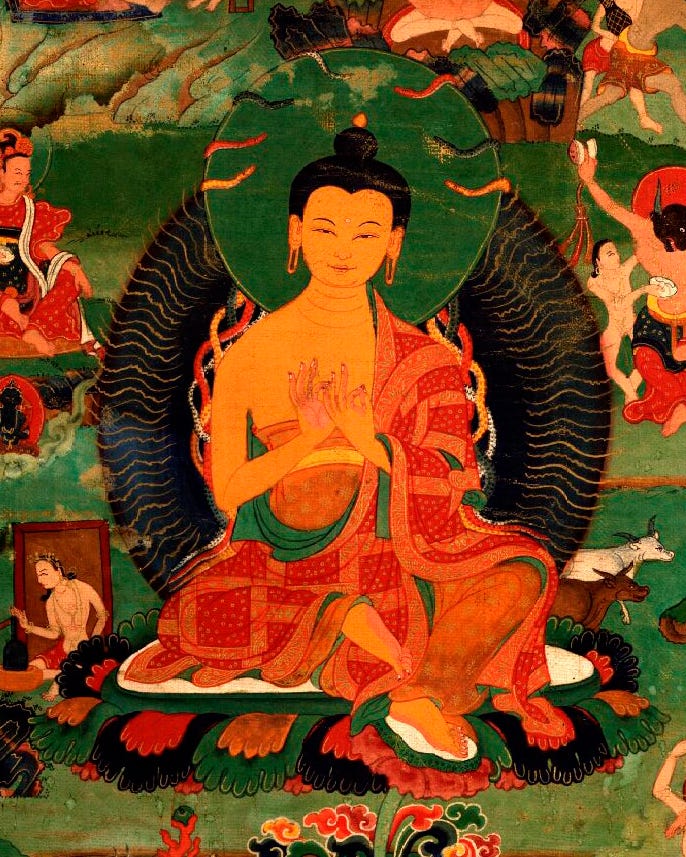
You might call Nagarjuna (circa 150-250) the Aristotle of the East. He founded the Madhyamaka (Middle Way)1 doctrine of Buddhist philosophy. I’m writing a shorter-than-usual post today to explain how he helped me enter a contest and how he continues to help me understand the self and the balance between the relative and the absolute.
About the contest: I read the Auraist substack because it does a great job of identifying great writers. I noticed this today in an email from that blog:
Do you know a valid (non-circular) justification for the existence of the self? In other words, can you prove that you exist? If so, send that proof in reply to this email and if it is indeed non-circular we’ll publish it, inform the world’s philosophers and major media, and send you a complimentary lifetime paid subscription to Auraist.
My mind immediately landed on Nagarjuna, and I sent this reply:
The self exists because we know that it does not.
Before I explain my reasoning, I’ll stipulate that I’m an expert on…well…nothing. I find both philosophical and early Buddhist texts close to indecipherable. So, what I know about Nagarjuna’s philosophy comes from reading modern experts explain it. The Fundamental Wisdom of the Middle Way: Nāgārjuna's Mūlamadhyamakakārikā by Jay L. Garfield is a book I rely on—not for Garfield’s translation but for his explanation.
As I understand it, Nagarjuna’s middle way is between relative reality (the world we perceive and live in daily) and absolute reality (the nondual world in which we are the sea and not the wave). Neither of those worlds is absolute. Through Buddhist practice and meditation, we see the tree across the street as empty (without permanent form and existence), but we can only perceive emptiness as relative to non-emptiness. So emptiness, too, becomes part of our relative world and is no longer empty.
Hence the famous line from the Heart Sutra:
…form is no other than emptiness, emptiness no other than form. Form is exactly emptiness, emptiness exactly form.
Applying that logic to the self, I know there is no fixed, permanent me. I can only know that (really know it) by experiencing that understanding in a meditative state of existence in the absolute world. Hence, the self must exist just as the nonself must exist, or neither exists (which is impossible).
I have no idea if that logic would stand up to a team of Eastern or Western philosophers, but it helped me have fun entering a contest, and maybe it will—regardless of its soundness—help you think about self and nonself, emptiness and form.
If you have found this blog post helpful, whatever your religious path, please share it with your friends.
From the Pure Land is read by subscribers in 21 US states and eight countries.
If you would like to receive new posts, please consider becoming a free or paid subscriber. With either option, you’ll receive all of the usual posts. To support my work, choose the paid option and receive occasional extended essays on more varied subjects.
A philosophy different from Gautama Buddha’s Middle Way between asceticism and self-indulgence.