
How Being Smart Makes Us Dumber
Modern research says education makes us better at defending our views, not changing them. The Buddha said the same thing.

In a study first circulated in 2013 and later published in the journal Behavioural Public Policy, Dan Kahan, a professor of both law and psychology at Yale, and three colleagues ran an experiment that should shock anyone who thinks education is a cure for faulty thinking.
They gave people a tricky data table to interpret, one that required real skill with numbers to read correctly. When the table was labeled as data about a new skin cream, people who were good with numbers read it accurately, regardless of their politics. When the same numbers were relabeled as data about a gun control law, that changed. The people who were best with numbers got more divided, sorting themselves neatly into whichever conclusion matched their politics, and defending it more skillfully than everyone else.
That’s not a fluke result. It has a name now, identity-protective cognition, and in a separate study, Kahan found the same pattern in how people evaluate climate data: more scientific literacy and numeracy doesn’t produce more agreement about the risk. It produces sharper disagreement, because both sides now have better tools for defending the position their group already held.
Michael Shermer, a historian of science, put the finding into one sentence that’s often quoted:
Smart people believe weird things because they are skilled at defending beliefs they arrived at for non-smart reasons.
He wasn’t only being cute. Most of us don’t form beliefs by weighing evidence and following it wherever it leads. We arrive at a position through upbringing, group loyalty, or a feeling that got there before any argument did, and then we go looking for reasons. The smarter you are, the better you are at finding them, and the better the reasons sound, even to you.
Social psychologist Jonathan Haidt described the same mechanism from a different angle in two books, The Happiness Hypothesis and The Righteous Mind, the more recent of which came out in 2012. His image is a rider on an elephant.
Reasoning is the rider, small and articulate, and intuition is the elephant, enormous and already moving. The rider’s actual job most of the time isn’t steering. It’s narrating a route the elephant already chose and making it sound like a decision. A skilled rider doesn’t make the elephant more responsive to argument. A skilled rider just tells a more convincing story about where it was always going.
I’m not advising against intelligence or education. I’m suggesting that raw cognitive skill is a tool that needs to be handled carefully. Used with genuine inquiry, it finds truth faster. Used to make a conclusion true, it’s worse than useless.

The Buddha was already saying this, and saying it without much patience, 25 centuries earlier. Some of the oldest material in the Pali canon, a set of poems called the Atthaka Vagga, the Octet Chapter, is devoted almost entirely to the danger of clinging to views. Any views. The moment you grip one tightly enough that letting go of it would feel like losing something of yourself, you’re clinging.
The Buddha was a master at creating stories to poke fun at human failings for teaching purposes. In the Cula-viyuha Sutta, he mocks an imaginary argument between contemplatives, each certain the others are fools. The Buddha’s diagnosis of what’s actually happening is exact:
Taking a stance on his decisions, praising himself, he says, “My opponent's a fool & unskilled.” That by which he regards his opponents as fools is that by which he says he is skilled.
Calling himself skilled he despises another who speaks the same way.
The same sutta goes further, describing what clinging to a view actually does to a person:
(H)e has consecrated, with his own mind, himself as well as his view.
The view and the self stop being two relative things. An argument against one becomes an attack on the other, which is exactly why a good counterargument so rarely works. You’re not disagreeing with someone’s opinion. You’re threatening the thing they’ve fused their identity to.
No amount of cleverness aimed at winning that fight was ever going to end it. Only letting go does that:
One who’s abandoned all decisions creates in the world quarrels no more.
Science and Buddhism have different terms for the cure. Kahan’s research points to what breaks the cycle. He calls it science curiosity, an appetite for surprising information even when it threatens what you already believe. People high in that trait become less polarized as they learn more, because they’re still capable of being interested in being wrong.
The Buddha’s version of the same openness is non-clinging, not the absence of a view but the absence of a death grip on one. You can hold a position the way you hold a tool, ready to set it down the moment it stops fitting the work, instead of holding it the way you hold your own name.
Japanese Zen master Shunryu Suzuki turned non-clinging into a positive phrase: beginner’s mind. In his book Zen Mind, Beginner’s Mind, he wrote:
For Zen students the most important thing is not to be dualistic. Our “original mind” includes everything within itself. It is always rich and sufficient within itself. You should not lose your self-sufficient state of mind. This doesn’t mean a closed mind, but actually an empty mind and a ready mind. If your mind is empty, it is always ready for anything; it is open to everything. In the beginner’s mind there are many possibilities; in the expert’s mind there are few.
What both science and Buddhism are describing isn’t a knowledge problem. It’s a grip problem.
May we all lose our grip.
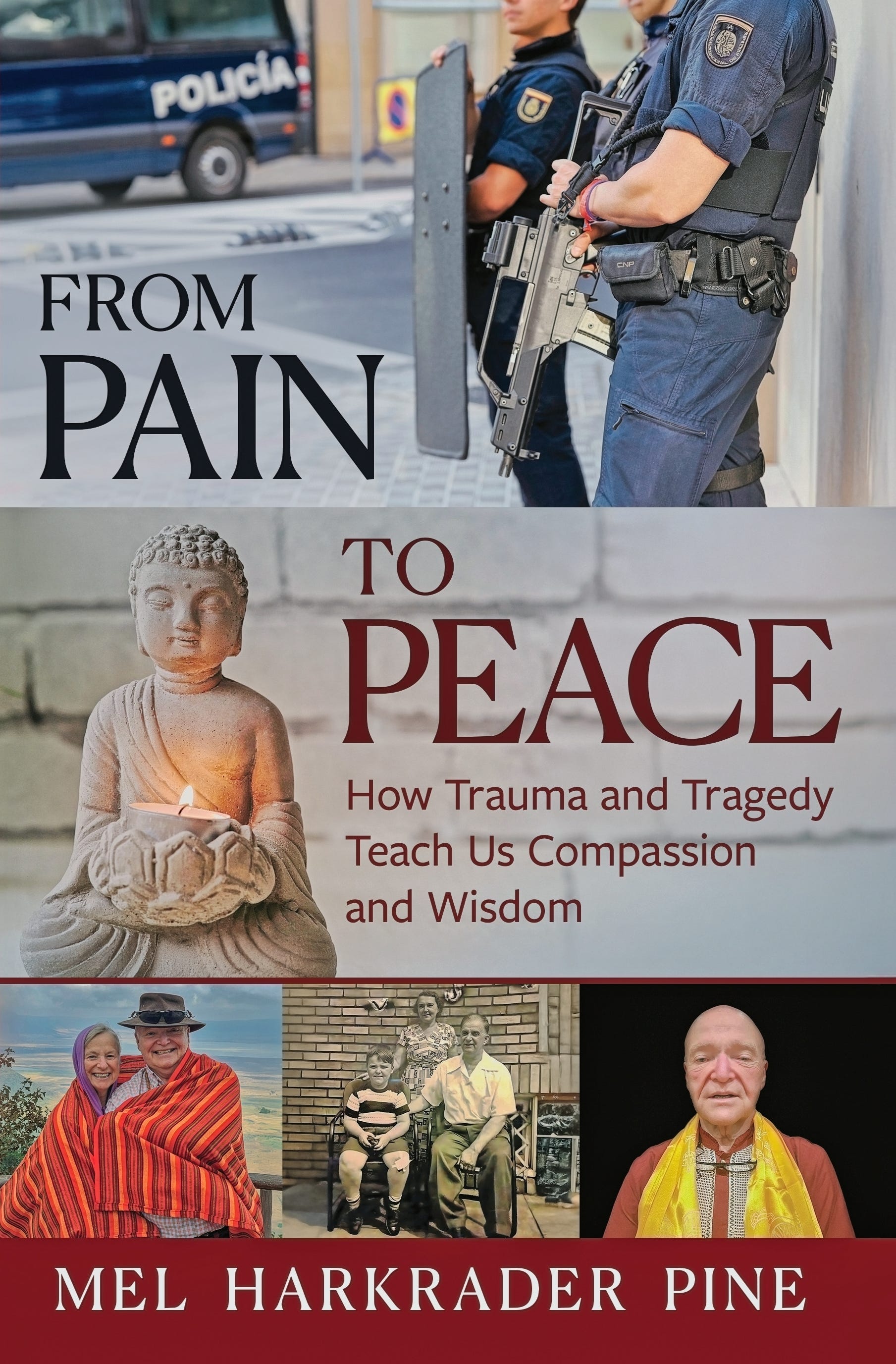
My spiritual memoir, From Pain to Peace: How Trauma and Tragedy Teach Us Compassion and Wisdom, goes on sale September 15, and its Kickstarter campaign begins July 18. You can help it to a good start by clicking on the “Notify me on launch” button on this Kickstarter preview page. Just that will tell Kickstarter to pay attention to my book.
My free newsetter, Awakening to Joy: Buddhism - AI - The Human Frontier, comes out on the 1st and 15th of every month.
A Buddhist Path to Joy is available worldwide in ebook, paperback, and audiobook format.
From the Pure Land has thousands of readers and subscribers in 47 U.S. states and 48 countries. Subscribe to receive each article in your email inbox.
If this piece resonated, consider sharing it with a friend.
Visit our sister Substack.
This is really good Mel. So relevant to our polarized time. And so pertinent to “clever” folks like me who are prone to forget how our inner world actually works. The rider on the elephant is a brilliant metaphor. Thank you!